Thymosin Alpha-1 benefits in clinical studies
Immune renewal is one hypothesis. Viral control, antibody changes and survival are the outcomes that give it consequences.
Chronic hepatitis B
Thymosin Alpha-1 has its most consistent positive clinical signals in chronic viral hepatitis. The lamivudine combination meta-analysis reported better virological responses and less viral breakthrough with added Thymosin Alpha-1 than with lamivudine alone.
The background to the Cochrane hepatitis B review protocol describes eight combination trials involving 583 people. HBeAg seroconversion occurred in 45.1% with the combination and 15.2% with lamivudine alone. HBeAg seroconversion means losing the hepatitis B e-antigen and developing the corresponding antibody. Naming that outcome matters: it gives the percentages a definite biological meaning.
I take the repeated hepatitis findings seriously, while giving the treatment context equal weight. These comparisons concern people with hepatitis B receiving particular antiviral combinations. The Cochrane document is a protocol that discusses earlier findings; it supplies no completed Cochrane verdict of its own.
Sepsis mortality
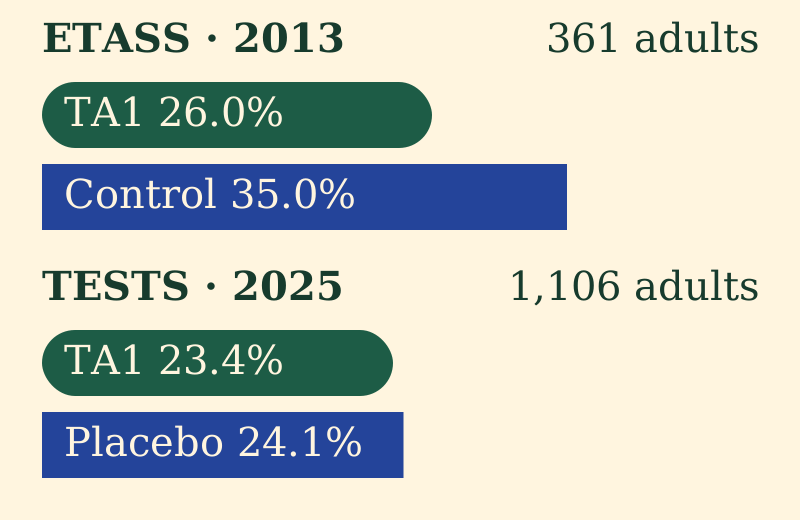
In sepsis, a dangerous response to infection, an earlier result looked encouraging. The ETASS trial of 361 people reported 28-day all-cause mortality of 26.0% with Thymosin Alpha-1 and 35.0% in controls. The nonstratified P value was 0.062; the log-rank P value was 0.049. The apparent statistical strength depended on the analysis.
The 2025 phase 3 TESTS trial enrolled 1,106 adults across 22 centres. Mortality at 28 days was 23.4% with the peptide and 24.1% with placebo. The hazard ratio was 0.99, with a 95% confidence interval of 0.77–1.27 and P=0.93. It found no statistically significant mortality benefit.
TESTS leaves the sweeping sepsis claims implausible to me. An immune mechanism can be active while the patient outcome fails to improve. The proposed link between restored immune function and survival needs to succeed in the trial itself.
T-cell changes during COVID-19
A retrospective review of 76 people with severe COVID-19 reported mortality of 11.11% with Thymosin Alpha-1 and 30.00% without it. The treated group also showed changes in T-cell numbers and exhaustion markers. Treatment had not been assigned at random, so the observations leave other explanations for the difference.
The later blood-cell experiment examined inflammatory signalling in a laboratory model, reducing TNF-α, IL-6 and IL-8 and increasing IL-10. That result helps investigate a mechanism. It has a different evidential role from following an ill person's recovery.
The COVID findings make immune restoration worth investigating. They give me insufficient grounds for a general treatment claim, especially with the negative sepsis trial already in the record.
Cancer combinations
The cancer-therapy reappraisal discusses Thymosin Alpha-1 with chemotherapy and immunotherapy in melanoma, liver cancer and lung cancer. Its interest lies in changing the immune environment alongside cancer treatment. The review draws on both preclinical experiments and clinical studies.
The combination idea strikes me as plausible; assigning credit to each treatment remains the hard experiment. The evidence described is about combination protocols. It establishes no basis for replacing established cancer care with the peptide.
Thymosin alpha 1 bodybuilding and ageing claims
The evidence collected here concerns immune function and illness. It includes antibody responses to vaccination and HIV immune-reconstitution measurements; it provides no demonstrated increase in muscle mass or strength. Thymosin Alpha-1 bodybuilding claims therefore outrun these studies.
Age-related immune questions also need an outcome attached. A better vaccine response is a specific finding. A claim about slower ageing or a longer life asks a much larger question, which those measurements leave unanswered.